Review Basics
for definition of whole and half steps and importance of Bert
and Ernie.
1. Start on C (3rd fret of A string).
2. Go one whole step higher to D (5th
fret).
3. From D go another whole step to
E (7th fret).
4. Next a half step. We are on E (Ernie)
so the very next fret is F (8th fret).
5. Continue following the formula
You might also
want to try starting on a C on another string. Can you find a
C on your B string (2nd string)? Using the same formula above
you will end up with a C major scale one octave higher.
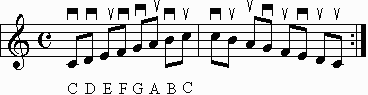
1st Position C Major
Scale
Playing a scale on one string is a great way to learn the fretboard
but not the most efficient way to play a scale. Try a 1st position
C major scale.
Start by putting your 3rd finger on low C (3rd fret of your
A string). Proceed to follow the alphabet from low to high using
the proper 1st position fingers as explained below.
Index finger looks after notes on
the first fret
Middle finger looks after the second
Ring looks after the third
Little finger on the fourth Note: the 4th finger is not needed
for this scale
Note:
D,G and B notes are open strings.
Note:
Concentrate on
using the correct fingers and saying the note names as you play.
Alternate Picking
Alternate picking involves alternating between down and up strokes
with the pick.
Practice alternate picking on an open string. When you feel comfortable
with the alternate picking proceed to play this scale as marked.
Start with a down stroke.
Try to tap your foot as you play. Listen=60
When alternate picking, pick down towards the floor as your foot
goes down and back up as your foot raises. Practice tapping your
foot and alternate picking on an open string before trying the
scale.
Natural Picking
Natural picking is a combination of alternate
and sweep picking. Alternate picking is the fastest way to play
on one string but sweep picking keeps the pick going in the
same direction when crossing strings and sometimes lets us go
even faster.
The importance of the pick hand can never be
underestimated. Many players tend to concentrate more on the
fret hand and believe it is their fret hand that lacks in obtaining
the speed they would like to have. 9 times out of 10 it is the
picking hand that is the problem. Just ask any violinist how
important the bow is. Our pick is no different.
Thank you for taking the time to
check out my page on basic chord construction! I hope
you found it to be helpful.
My name is Teague Purtell and I
have been playing and teaching music for over 20 years.
This site is an extension of me and my love of sharing
music.
The members section is
a complete online guitar method I have been developing
since I first put this site online in 1999. My main purpose
is to make learning the guitar easy and fun for you!
I hope you allow me to
be part of your guitar learning journey :)

 =
60 (right
click to open in new window)
=
60 (right
click to open in new window)